


 Clinic Tips
The Hidden Cost of the Paper Token Register
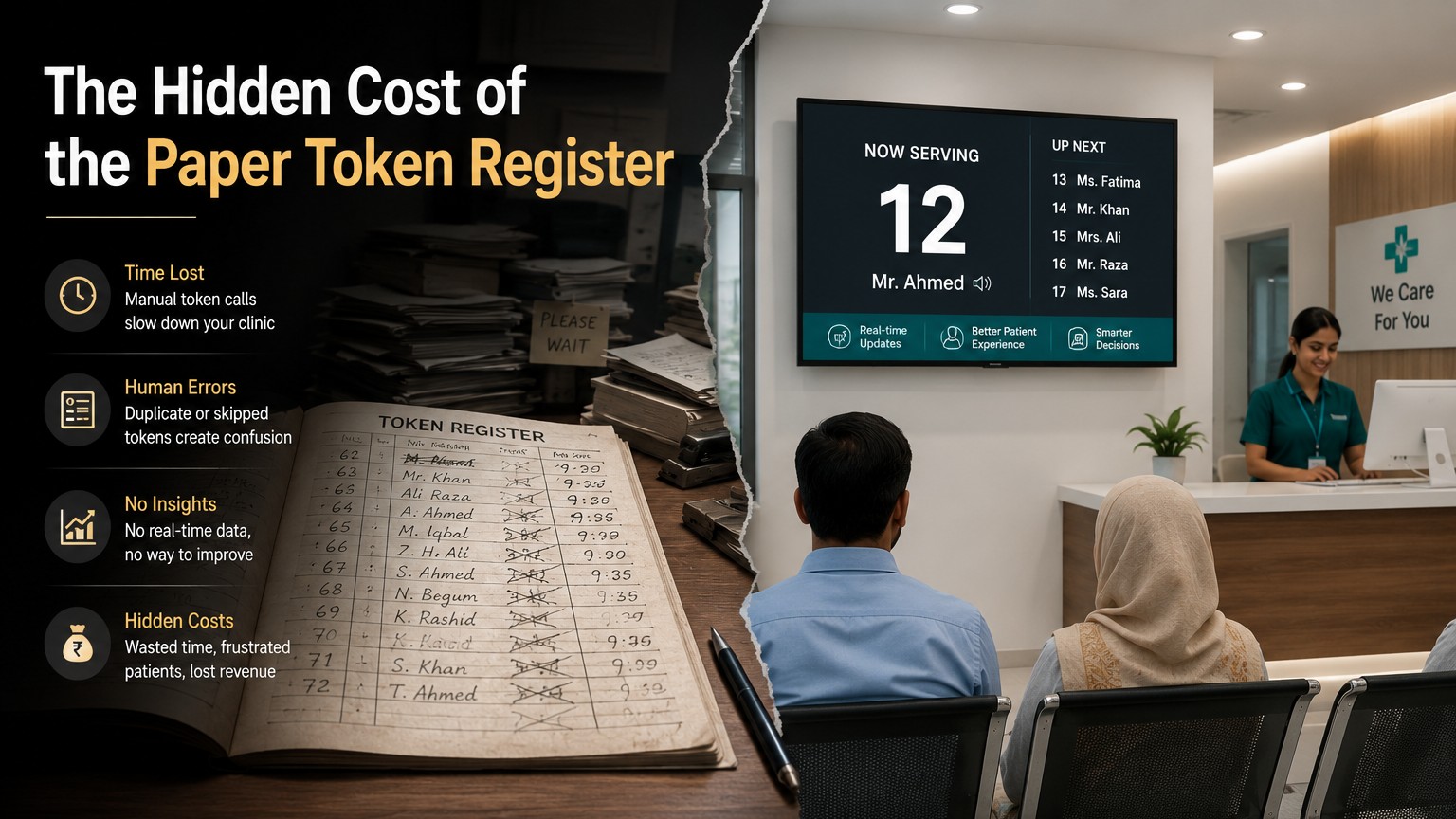
Walk into almost any clinic in Pakistan and you will hear the same phrase: "Number 14, please wait." Nobody knows how long that wait actually is — not the patient, not the receptionist, sometimes not even the doctor. It feels normal because every clinic does it this way. But normal is not the same as free. A paper token register has a cost. It is just spread out, hidden inside wasted hours, tired staff, and patients who quietly choose a different clinic next time.
The Problem With "Please Wait"
A paper register can tell you a number. It cannot tell you a time. A patient who is told to wait has no idea if that means fifteen minutes or two hours, so they do the only rational thing: they arrive early and sit. Multiply that by every patient, every day, and a clinic ends up with a waiting room that is fuller and noisier than it needs to be — not because the clinic is busier than it should be, but because nobody could tell patients when to actually come.
What a Paper Register Actually Costs You
The cost shows up in places that never appear on a balance sheet. Receptionists spend their morning managing a physical queue instead of managing patients — calling out numbers, settling disputes about who was actually next, flipping through pages to find an old token. Doctors lose the rhythm of their day because there is no way to see how the queue is moving from inside the consultation room. And patients, who have no visibility at all, form their first impression of the clinic while sitting in a plastic chair wondering if they have been forgotten.
None of this is anyone's fault. It is simply what happens when a real-time problem — who is next, and when — is managed with a tool that cannot update in real time: paper.
The Three Things Patients Actually Want
Ask any patient what they want from a clinic visit and the answer is rarely about the doctor's skill — they usually trust that already. What they want is much simpler: to know how long the wait will be, to not have to ask twice, and to not have to stand in a crowd to find out. A queue that answers those three questions on its own, without a staff member having to explain it fifteen times a day, changes how a patient feels about the entire visit before they have even seen the doctor.
What Changes When the Queue Goes Digital
The moment a clinic moves to a digital queue, the guesswork disappears. A patient books a token and gets a live link that updates automatically — they can see their position from home and time their arrival instead of camping in the waiting room. The receptionist is no longer the keeper of a physical line; the system keeps the line, and staff are free to actually help patients instead of managing a queue by hand. The doctor gets a clear view of who is next and how the day is pacing, so consultations start on schedule instead of in bursts.
The waiting room itself changes. It gets quieter, less crowded, and less tense — because most of the "waiting" is now happening at home, on a phone, not in a chair.
It Is Not Just About the Queue
Once a clinic's queue is digital, everything downstream gets easier too. Prescriptions are attached to the same token link instead of being written on a slip that gets lost by the time the patient reaches the pharmacy. Fees are recorded automatically as each token is served, instead of being tallied by hand at the end of the day. And because the whole visit — booking, wait, consultation, prescription — lives in one place, there is finally a clear, searchable record instead of a stack of paper that only makes sense to the person who wrote it.
Making the Switch Without the Headache
The biggest fear clinic owners have about "going digital" is that it will be complicated — new software, new training, a system built for a hospital ten times their size. That fear is fair, because a lot of healthcare software really is built that way. But a clinic does not need hospital software. It needs something a receptionist can learn in an afternoon and a doctor can run without thinking about it.
That is the entire idea behind Doctorje: a digital queue built for the clinic you actually run, not the hospital someone else imagined. If your waiting room still runs on "number 14, please wait," it might be worth seeing what a quiet, on-time waiting room looks like instead.
Share this article
Comments
Be the first to comment.